Palantir’s “Technological Republic”: The Dystopian Manifesto Hiding in Plain Sight
Palantir’s 22‑point “mini‑manifesto” isn’t just branding, it’s a blueprint for a surveillance‑heavy, permanently mobilized West sliding toward authoritarianism.


Over the weekend, Palantir, one of the most powerful surveillance and war‑tech companies on earth, published a political manifesto on X (formerly Twitter). It’s titled:
“Because we get asked a lot. The Technological Republic, in brief.”
The post is a 22‑point thread from Palantir’s official account, @PalantirTech, and the company describes it as a “brief” summary of CEO Alexander Karp’s book The Technological Republic: Hard Power, Soft Belief, and the Future of the West.
You can read the manifesto yourself here:
X thread (22‑point manifesto):

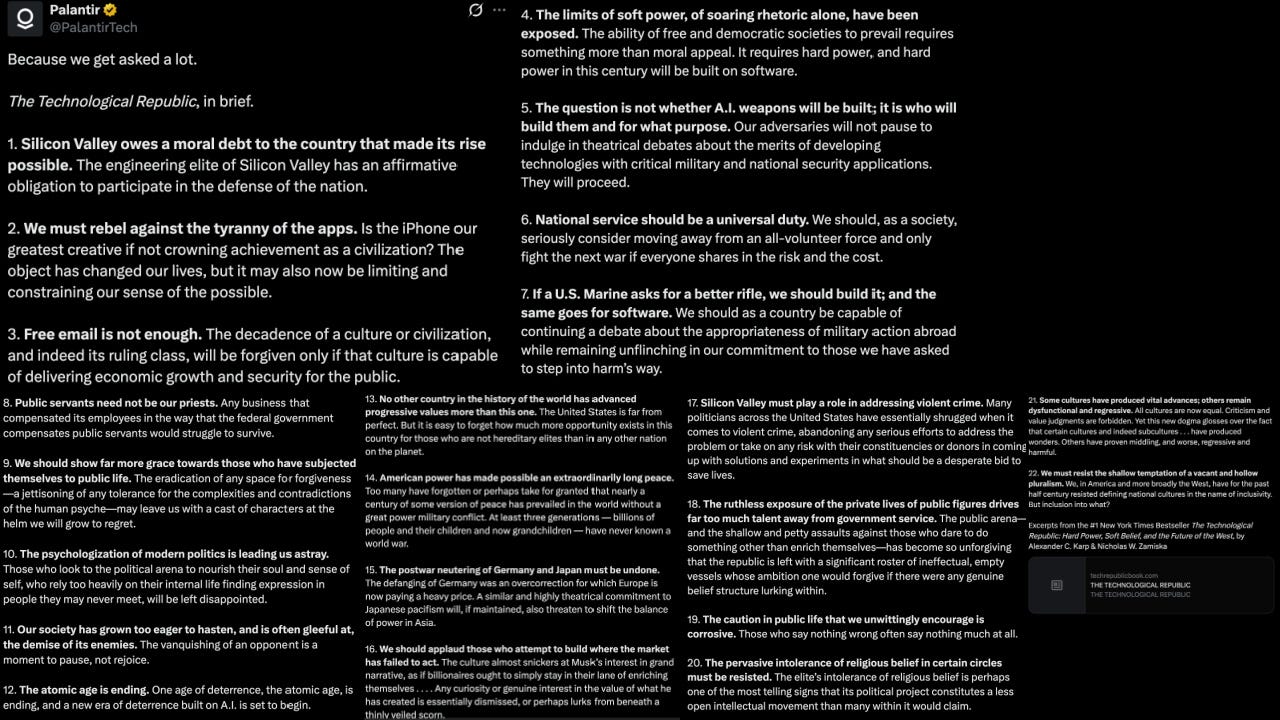
And you can find the underlying book here:
Official site
Publisher page (Crown Currency / Penguin Random House)
The book is widely sold as The Technological Republic: Hard Power, Soft Belief, and the Future of the West by Alexander C. Karp and Nicholas W. Zamiska, published in 2025.
Tech outlets are already describing the thread as a “mini‑manifesto” that defends AI warfare, calls for national service, and denounces pluralism and “regressive” cultures.
With the help of A.I., I’m going to translate this manifesto into plain language and explain why so many people are reading it as dangerous and authoritarian, not visionary.
Before we go further, three quick definitions so we’re on the same page:
Authoritarianism is a style of rule where power is concentrated in the hands of one leader or a small elite, political freedoms are restricted, and ordinary people have little real say or protection.
Pluralism is the belief that a healthy democracy should include many different groups, identities, and viewpoints sharing power, coexisting peacefully, and having a voice in decision‑making.
Technological republic (in Karp and Zamiska’s sense) is a system where the state and the software/tech industry are deliberately fused into a single project: a governing elite of engineers and officials using advanced technology, especially AI and data systems—to protect and advance “the West.” It’s a union of government power and the software industry that treats technologists as a kind of ruling class with a special duty to shape security, war, and national identity.
Keep those in mind as we walk through what Palantir is actually arguing for.
What Exactly Is This Manifesto?
Formally, it’s:
A roughly 1,000‑word, 22‑point statement Palantir posted on X on April 17–18, 2026, under the heading: “Because we get asked a lot. The Technological Republic, in brief.”
A public distillation of the ideas in The Technological Republic, which the authors themselves describe as “the beginnings of the articulation of the theory behind Palantir’s work.”
Substantively, it’s a list of sharp claims about:
Silicon Valley’s “moral debt” to America,
The need to pivot from “apps” to AI‑driven hard power,
The inevitability of AI weapons,
The superiority of certain cultures over “dysfunctional and regressive” ones, and
The emptiness of “vacant and hollow pluralism.”
Think of it as Palantir’s ideological mission statement, not just a marketing blurb.
Who Is Palantir and Why Should We Care?
Palantir is not a neutral productivity app. It is a surveillance and analytics contractor that builds platforms for:
Militaries: battlefield intelligence, targeting support, operational planning.
Intelligence agencies: data fusion across signals, human, and open‑source information.
Law enforcement & immigration: predictive policing, criminal intelligence dashboards, ICE and border‑control analytics.
Company executives have acknowledged that their products are used “on occasion, to kill people,” referring to their role in identifying and targeting enemies on the battlefield.
Journalists and analysts have repeatedly called Palantir “terrifying” and “one of the most secretive and powerful companies in America” because of its reach into security, policing, and immigration systems worldwide.
So when this company publishes a manifesto about what kind of society it thinks the West should become, that’s not just tech talk, it’s a glimpse into the political logic guiding tools that already shape people’s lives.
What the Manifesto Actually Says:
1. AI Weapons and “Hard Power” as the Backbone of the West
The manifesto declares that “the atomic age is ending” and that a new era of deterrence based on AI‑driven systems is about to begin.
It states:
“The question is not whether A.I. weapons will be built; it is who will build them and for what purpose.”
At the same time, it argues that “the limits of soft power, of soaring rhetoric alone, have been exposed,” and that hard power in this century “will be built on software.”
In plain language:
AI weapons and militarized software are treated as unavoidable facts, not political choices.
Traditional tools of influence, diplomacy, human rights, moral example—are dismissed as insufficient.
The manifesto insists that free societies must embrace software‑driven war and surveillance to survive.
This is how you normalize an AI arms race: by calling it destiny and branding anyone who resists as naive.
2. Silicon Valley’s “Moral Debt” to the State
The opening points insist that:
“Silicon Valley owes a moral debt to the country that made its rise possible.”
“The engineering elite of Silicon Valley has an affirmative obligation to participate in the defense of the nation.”
Karp and Zamiska’s book makes exactly the same case: that America’s “technological elite” must become a governing elite, realigning with the state the way scientists did during the Manhattan Project and early Cold War.
This is techno‑nationalism:
Tech workers are not just private employees; they are soldiers of the nation in waiting.
Tech companies are not neutral; they are expected to fuse with the national security apparatus.
To Palantir, the future belongs to the engineers who stop building “apps” and start building weapons and surveillance systems for the state.
3. A Militarized Model of Citizenship
The manifesto calls for national service to be a universal duty and argues that if a U.S. Marine asks for a better rifle or better software, “we should build it.”
It praises American military power for providing “an extraordinarily long peace,” and says the “postwar neutering of Germany and Japan must be undone,” implying that allies should be re‑armed and more willing to fight.
The civic ideal here is:
A society on permanent wartime footing,
Citizens defined by their willingness to serve in military or security roles,
Peace maintained not by demilitarization, but by constant, technologically enhanced strength.
That is a fundamentally different vision of democracy than one organized around rights, social welfare, and peaceful pluralism.
4. Ranking Cultures and Attacking Pluralism
The most openly alarming part of the manifesto is the section on culture:
“Some cultures have produced vital advances; others remain dysfunctional and regressive.”
It denounces what it calls “vacant and hollow pluralism,” and mocks the claim that all cultures are equal.
Remember our earlier definition: pluralism is the idea that diverse groups and ways of life can and should coexist peacefully in one political community, each having a voice and a measure of power.
The manifesto does the opposite. It argues for a civilizational hierarchy:
Some cultures (clearly including “the West”) are framed as advanced and vital.
Others are labeled middling, or worse, “regressive and harmful.”
Pluralism and inclusivity, core commitments of diverse democracies, are reduced to dangerous illusions.
Tech reporters note that this mini‑manifesto “denounces inclusivity and ‘regressive’ cultures” in the same breath that it calls for AI weapons and national service.
When a company that builds predictive policing and migration‑control platforms talks about “regressive” cultures, it is fair to ask: which communities do they have in mind, and how will that judgment show up in code?
5. Religion, Elites, and “Intolerance”
Several points complain about a “pervasive intolerance of religious belief in certain circles” and portray Western elites as hostile to religion.
The underlying book argues that the West has grown intellectually fragile and must recover a stronger sense of identity and belief.
Taken together, this is a defense of a particular religiously inflected Western identity that needs to be protected from secular liberal culture.
6. Less Scrutiny for the Powerful
The manifesto also attacks “the ruthless exposure of the private lives of public figures” and warns that a culture “gleeful” about the demise of its enemies drives away talented people from government service.
In short:
Investigative reporting and public accountability are framed as a problem,
Powerful figures are treated as fragile resources that must be shielded from too much scrutiny.
Coming from a secretive contractor already embedded across governments, this is less a complaint and more a request: more power, fewer questions.
Why This Is So Dangerous
Taken point by point, you might mistake this for a very hawkish essay. But as a whole, and given who’s writing it, it adds up to something darker: an ideological justification for a high‑tech security state run by a fused tech‑security elite.
Here’s where the word authoritarianism comes in. Scholars use that term for systems where power is concentrated in a leader or small group, political competition is limited, and civil liberties and checks and balances are eroded. Those systems often maintain control through fear, surveillance, and the suppression of dissent.
Palantir’s manifesto is not announcing a full‑blown dictatorship. But its logic leans hard in that direction: more concentrated power, more surveillance, fewer real constraints.
1. It Normalizes an AI Arms Race
By insisting that AI weapons are inevitable and that adversaries “will proceed” regardless of what we do, the manifesto tries to shift the Overton window:
The debate is no longer whether these systems should exist.
The only “adult” question becomes who controls them and how aggressively they are deployed.
That logic is how societies sleepwalk into permanent, automated militarization.
2. It Elevates Tech Contractors Above Democratic Oversight
The book’s reviewers note that Karp and Zamiska want America’s technological elite to become a de facto governing elite, working hand‑in‑glove with the state to direct grand projects and security policy.
But private contractors like Palantir:
Are not elected,
Are bound to shareholders and clients, not citizens, and
Operate behind layers of secrecy agreements and proprietary code.
When they also argue that leaders should be more willing to ignore public criticism and think in “civilizational terms,” you get a recipe for unaccountable, semi‑private rule.
3. It Marries Cultural Hierarchy With Surveillance Infrastructure
Palantir’s software helps governments identify threats, predict crime, and monitor populations.
Combine that with a manifesto that:
Calls some cultures “dysfunctional and regressive,”
Treats pluralism as a lie, and
Frames certain ways of life as harmful to civilization,
and the danger becomes obvious:
Communities labeled “regressive” are more likely to be over‑policed, over‑surveilled, and over‑targeted.
Civil liberties become conditional on whether your group is seen as “vital” or “harmful.”
That’s not speculative; it’s how predictive policing, counter‑terrorism lists, and immigration analytics have already been used against marginalized groups.
4. It Calls for Perpetual Mobilization and Less Dissent
National service as a “universal duty,” the push to re‑arm allies, and the insistence on AI‑backed hard power all point toward a society in permanent mobilization mode.
Meanwhile, the manifesto tells us we should relax scrutiny of powerful figures because accountability scares “talent” away from public life.
That combination, more war, more surveillance, less dissent, less scrutiny, is the opposite of a healthy, plural, democratic order.
The Future They Want vs. the Future We Choose
Palantir’s “Technological Republic” manifesto is a rare document: a powerful company showing us, almost line by line, the world it wants to build.
That world is one where:
AI weapons and surveillance are the unquestioned backbone of security.
Tech elites and security agencies fuse into a ruling “technological republic.”
Cultures are ranked and some are written off as “regressive and harmful.”
Pluralism and inclusivity are dismissed as hollow slogans.
Public scrutiny of the powerful is treated as a threat, not a democratic safeguard.
This isn’t just rhetoric layered on top of a neutral product. It’s an ideology directly tied to software that already helps decide who gets watched, who gets stopped, and who gets targeted.
With the help of AI, I’ve tried to translate this manifesto into plain language because the most dangerous ideas are often the ones hiding in jargon and grandiose prose. Once you strip that away, what’s left is clear:
Palantir is not just selling software. It is selling a political project.
The real question for the rest of us is whether we are willing to let that project quietly become our new operating system, or whether we insist on a different future, one where technology serves a genuinely democratic, plural, and peaceful society instead of a high‑tech security state.

About The Author: Tabitha Speaks is a political commentator and opinion journalist who breaks down the headlines from Congress, the White House, the Supreme Court, and state politics into clear, no-nonsense explainers. Her work centers on helping everyday voters sort fact from spin so they can walk into the voting booth informed, not confused. She also hosts the “Shining a Light” podcast, where she explores everything from political scandals to religious cults and other stories that deserve a closer look. The views expressed are her own and do not represent any employer or organization. Follow Tabitha on TikTok, YouTube, Instagram, and Threads @therealtabithaspeaks.
Thank you Ms. Tabitha for your long form report. Palantir is already a part of the tRump regime. Surveillance systems are probably being coded & beta tested as I write this.
Tabitha, we need to rebut every single one of these bullet points. They are gobbledygook designed to redirect us away from what they really are doing, based on their own, illogical assumptions.